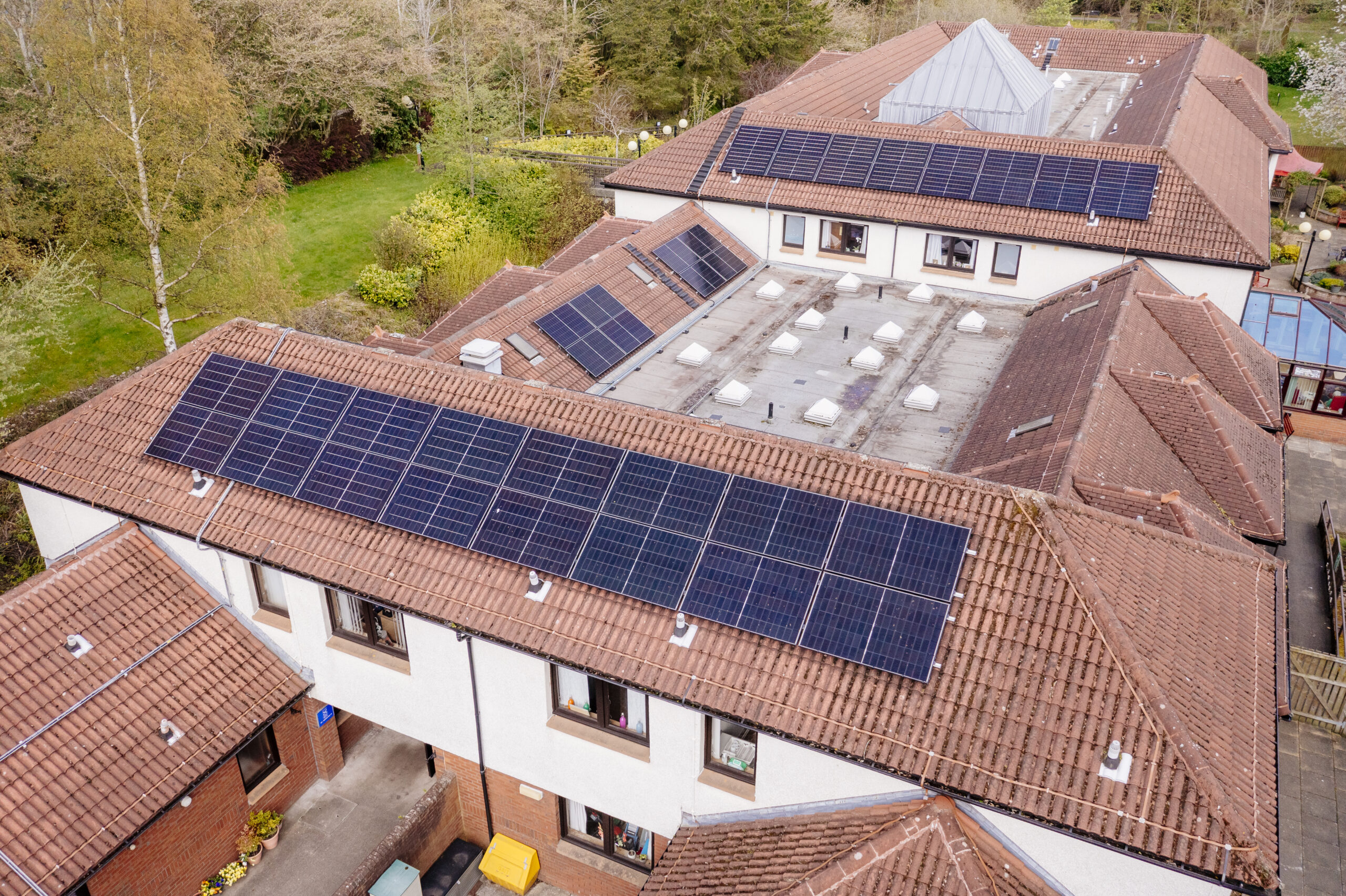
St Margaret’s House is a specialist care home operated by CrossReach, providing accommodation and support for up to 36 older people living with dementia. Located on the outskirts of Polmont, the building sits within its own grounds beside a local park and operates continuously, with a consistent demand for energy to support resident care and daily operations.
Gensource delivered a rooftop solar PV system at St Margaret’s House to support the site’s transition to low‑carbon energy while maintaining the high standards required in a sensitive care environment. The system was designed in line with RC62 guidance as far as practicable, ensuring safety, compliance, and insurer requirements were fully considered.
The system is expected to generate approximately 18.97 MWh of energy per year, delivering annual carbon savings of 3.67 tonnes of CO₂.
This is equivalent to planting around 169 trees each year, contributing to reduced environmental impact while supporting the ongoing operation of the care home.
A range of additional safety and compliance measures were incorporated, including arc boxes, bird netting, and covered cable trays. Installation quality was independently inspected by an external Clerk of Works during the build and on completion.
The project was supported through CARES funding. CARES (Community and Renewable Energy Scheme) is a Scottish Government programme delivered by Local Energy Scotland that supports the installation of renewable energy technologies, while helping host organisations access low‑carbon energy.
At St Margaret’s House, CARES funding supported the installation of a solar PV system owned by Eco‑Congregation Scotland. Under a Power Purchase Agreement (PPA), Eco‑Congregation Scotland then sells the energy generated on site to CrossReach, who own and operate the care home. This model enables local renewable energy generation while delivering long‑term benefit to both organisations, without the need for upfront capital investment by the care provider.
The St Margaret’s House project demonstrates how CARES‑supported solar PV can be successfully delivered on occupied care settings. Through careful design, independent quality assurance, and an appropriate commercial model, the project provides reliable low‑carbon energy while meeting the operational and safety requirements of a specialist care environment.