
Standalone or Hybrid Battery Systems – Which is Right for You?
When it comes to battery energy storage, two main types of battery systems stand out: standalone and hybrid. Each offers distinct advantages and considerations, making the choice between them a crucial decision for homeowners and businesses alike. Let’s delve into what standalone and hybrid systems entail, along with their respective benefits:
Understanding Standalone and Hybrid Battery Systems:
Standalone Battery Systems:
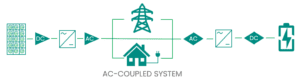
Standalone, or AC-coupled, battery systems are, as their namesake, battery storage systems that are completely standalone and can operate independent of your solar or wind generation (in this article, we will focus on soar for ease). In this setup, DC electricity generated by solar panels is converted to AC electricity by its own inverter. Excess energy not immediately used in the home or business is then directed to a standalone battery unit, where it is stored for later use.
Hybrid Battery Systems:
On the other hand, hybrid battery systems integrate both solar energy conversion and battery storage functionalities into a single unit. These systems, have a single inverter charger, which will take the DC energy from the solar, battery, or both, and convert it into AC energy to be used on-site. As demonstrated in the image below, the solar and battery are connected almost directly.

Advantages of Hybrid Battery Systems:
One Inverter to Rule Them All: Hybrid systems streamline installation by consolidating solar energy conversion and battery storage into a single unit, reducing the number of components and space required.
Only One Inverter to Replace: With a hybrid system, there’s only one inverter to maintain or replace over its lifespan, minimising potential points of failure compared to standalone systems. This reduces maintenance costs and can increase system reliability.
Independent Inverters and Batteries: Hybrid systems offer compatibility with various batteries, providing flexibility for future upgrades or replacements. Users can choose from a range of battery options to suit their specific energy storage needs.
Maximizing Grid Supply: Hybrid inverters allow users to maximize solar and battery output while requiring only one connection to the grid. This enhances energy independence and reduces reliance on grid-supplied electricity. With more renewables on the network, grid connections can be tough, so getting more energy generation from a limited connection can be vital. Gensource can handle this process and advise on the best system.
Oversizing Potential: Hybrid systems enable oversizing of solar panels beyond the inverter’s capacity, ensuring efficient use of available solar energy. This allows users to maximise their energy production and storage capabilities. For example, modern inverters can put up to 200% more solar, than the AC power output, in some cases even more. Where a bigger inverter is not possible, the excess energy can still go direct into the battery. This maximises the utilisation of your energy generation.
Round-Trip Efficiency: By minimising the number of energy conversions, hybrid systems can offer better round-trip efficiencies compared to standalone systems, especially for storing excess energy. This results in less energy loss and increased overall system efficiency.
For Example, if you have excess solar with a standalone battery, it is converted to AC by the inverter, then back to DC for the battery, then back to AC when needed to power the sites electrical loads. Now if you are using that power for office laptops or charging a car, you may be converting to DC yet again! Hybrid systems overcome this by allowing Solar power to go straight to the battery without converting to AC. This increases storage efficiency.
Advantages of Standalone Battery Systems:
Greater Flexibility of Location: Standalone batteries can be installed in various locations due to their self-contained nature, offering flexibility in system design. This allows for optimal placement. There is no DC cabling, so you are not limited by the location of your renewable generation.
Retrofitting into Existing PV Systems: Standalone batteries are ideal for retrofitting into existing solar power systems without the need to replace the inverter, making them a cost-effective option for upgrades. This allows users to enhance their existing solar setups with energy storage capabilities.
More Total Power Output: Standalone batteries often have higher output capacities than hybrid inverters, providing more power to meet demand and support fast charging. You can have the maximum power output from your solar panel system, and the maximum output of your battery, at the same time. This allows for greater energy storage capacity and faster recharge times, enhancing overall system performance.
Integration with Third-Party Monitoring Systems: Standalone systems allow for easier integration with third-party monitoring and control systems, offering more flexibility and future-proofing. This enables users to monitor their energy consumption and production more effectively and make informed decisions about their energy usage.
Additional Functionality: Whilst both hybrid and standalone systems can offer additional services above increasing self-consumption of your on-site generation. AC coupled systems can do this completely independently of any solar generation allowing greater flexibility of uses such as taking advantage of off-peak energy tariffs or providing grid flexibility services to earn extra income. This allows users to optimize their energy usage and potentially generate additional revenue from their energy storage system.
In conclusion, both standalone and hybrid battery systems offer unique advantages depending on specific requirements and preferences. At Gensource, we find that those looking to install energy technologies such as solar, wind and energy storage, are driven by various factors, doing more with their own energy, reducing costs and also reducing reliance on the grid. Each client also, has their own unique circumstances, such as energy usage patterns and available space. By engaging expertise, such as Gensource, you can make sure you are investing the best energy system for you.

